
Bobby Charles Unveils Property Tax Reform Plan: $100,000 Homestead Exemption, Fully Reimbursed by the State

October 6, 2026
First budget doubles the exemption to $50,000 and lifts municipal reimbursement from 76 percent to 100 percent, paid for with $161 million in identified savings — not a tax increase.
AUGUSTA, Maine — Republican candidate for Governor Bobby Charles today released his property tax reform plan, a phased increase in Maine’s Homestead Exemption to $100,000, with the state reimbursing municipalities for 100 percent of the revenue they forgo. The first biennial budget would double the exemption from $25,000 to $50,000 and raise the state’s reimbursement rate from 76 percent to 100 percent, at an estimated cost of $160 million a year, offset by $161 million in identified savings.
“Maine families are being taxed out of the homes they already own,” Charles said. “The Homestead Exemption is supposed to cut that bill. Augusta has let it fall behind, then shorted towns on the reimbursement and left local taxpayers to make up the difference. We will raise the exemption, pay towns in full, and pay for it by stopping the growth of state government — not by sending the bill somewhere else.”
What the plan does
The Homestead Exemption reduces the taxable value of a Maine resident’s primary home. The state is supposed to reimburse the municipality for the revenue that reduction costs. Today the exemption is $25,000, and the state reimburses only 76 percent of the lost value. Towns absorb the other 24 percent, and many make it up in the mill rate.
Charles’s plan has three parts.
•Double the exemption to $50,000 in the first biennial budget, then raise it in later budgets until it reaches $100,000. Each additional $25,000 costs roughly $95 million a year. Reaching $100,000, with full reimbursement, is estimated at $285 million.
• Raise the state reimbursement rate from 76 percent to 100 percent at the same time, so towns are not left holding the bag. The FY 2026 budget included $92 million for the Homestead Exemption. Full reimbursement of the current exemption would cost about $34 million more. Raising the exemption by $25,000 would cost about $126 million. Together, the first-step package is about $160 million a year.
• Restore the $25 million cut from the Homestead Exemption in the latest state budget, so the starting point is the exemption Mainers were already promised.
How it is paid for
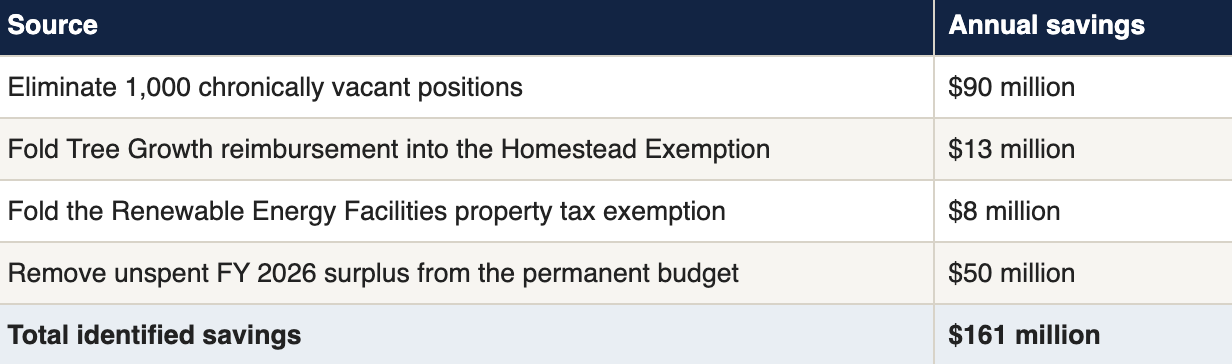
The first-step increase, about $160 million a year, is covered by $161 million in savings already identified in the state budget. No broad-based tax increase is required.
Where the savings come from
• Vacant positions. In FY 2025 the state had about 2,000 vacant positions. The FY 2026 budget added another 257. Eliminating 1,000 chronically vacant positions saves about $90 million a year and stops the growth of state government through attrition, not layoffs. State employees received a 29 percent wage increase in just under five years — more than in the previous 16 years combined — while private-sector workers in Maine saw 21 percent. The Legislature gave itself a 61 percent pay raise over the same period.
• Tree Growth reimbursement, about $13.2 million. Maine is roughly 90 percent forested. The plan folds this dedicated reimbursement into general homestead relief rather than continuing a separate incentive to conserve trees on private land.
• Renewable Energy Facilities property tax exemption, about $8 million, folded into the Homestead Exemption so the benefit goes to homeowners rather than a narrow class of facilities.
• Unspent surplus. About $50 million of the $148 million FY 2026 surplus was budgeted and never spent. Those appropriations should come out of the permanent budget.
Local flexibility, restricted to tax relief
The plan would let municipalities place a surcharge on residential properties that are not occupied year-round and are assessed above $1 million. The surcharge would apply regardless of the owner’s state of residence, and every dollar would be restricted to property tax relief. It is a local option, not a statewide tax on nonresidents, and it is written to avoid treating owners differently based solely on where they live.
Permanent fixes for costs that drive local taxes
Raising the exemption is not enough if Augusta keeps pushing new costs onto the property tax. The plan targets three drivers without a blank check and without cutting services.
• County jails. About 6 to 8 percent of local property taxes go to county programs, much of it for jails. Counties now cover about 80 percent of jail costs, roughly $115 million statewide on local property taxpayers. Holding people charged with crimes is a statewide responsibility, not a town-by-town one. Charles is calling for a permanent funding reform, not another one-year patch.
• Special education. This single category can consume up to 10 percent of a municipal budget and 20 percent of a school district’s revenue. The plan calls for working with the federal government to meet the goals of the law, protect students with special needs, and seek waivers from rules that do not fit Maine’s circumstances — lowering cost without lowering the obligation to those students.
• Career and technical education. Some funding now used for free community college tuition for recent graduates, in any field the system offers, would be limited to areas of greatest workforce need and redirected to Maine’s 27 technical centers. Students could enter the workforce sooner, at no tuition cost, and local school budgets would receive support they do not get today.
What it means on a tax bill
Take a home in Auburn assessed at $200,000, with a mill rate of $24.50 per $1,000. The bill today is $4,900. The current $25,000 exemption lowers it by $612.50, to $4,287.50. The state reimburses the city $465.50. The city is short $147.
Raise the exemption to $100,000 and the taxable value falls to $125,000. The bill falls to $3,062 — $1,837 less than the full bill. At the current 76 percent reimbursement, the city would recover only about $1,396 and lose roughly $441. That is why the plan pairs the higher exemption with 100 percent reimbursement. Homeowners get the cut. Towns do not have to raise the mill rate to pay for it.
The larger point
Charles tied the tax plan to the rest of his affordability agenda: lower costs for health care and electricity, and an economy that lets working Mainers keep more of what they earn. “A bigger exemption only works if the state pays for it and stops handing towns new bills,” he said. “That is the difference between relief and a press release.”
Bobby Charles is the Republican nominee for Governor of Maine and a native of Wayne, ME. He is a Navy veteran and former federal investigator. Learn more about Bobby’s plan to turn Maine around at BobbyForMaine.com.